Here are my comments on professional blogs:
School Library Monthly: Share the Wealth
What a great post. We all come up with so many great ideas in
development, but they do not mean much until we place them in practice. I
think the question you ask and the framework for answering it are
great.
But Barbara Jansen’s question is a great one: “what will you do on
Monday based on what you learned and contributed this weekend.”
You really took this to heart and the graphical answer does a great
job at getting down to brass tacks. That is an approach I am going to
steal myself. The more we can do to think about these great ideas and
approaches in the context of our own situations and our own users, the
more effective we will be. Thanks for your insight!
PS: Isn’t it funny that those forms we fill out can include such rote
questions, when we work so hard in our everyday lives to design
inquiry-based assignments with thoughtful questions? Always seemed
ironic to me!
YALSA: BULLYING NOT JUST AN ISSUE FOR ONE MONTH
You could not be more right.
This is such a real issues, and one that everyone needs to continue to help grow awareness about. It is something that librarians can help not only with information and resources, such as the ones you provide, but also by being the adult and intervening. Particularly when we as librarians often oversee the more informal interactions of students, we have to stand up against bullying, or even the hint of it right away.
But this bullying extends well beyond the school halls today, as the two examples you cite mention. The role of technology and web 2.0 have changed the nature of bullying, and we must be cognizant to the confrontations students can face online. This is where libraries and information literacy can continue to help. Children no longer "turn off" their social selves when they get home but have to learn how to effectively and safely enmesh these technological tools with their own self-development. Its challenging.
The more adults can help in this process the better. But bullying is an ongoing problem, and one we cannot ignore, even after its month in the spotlight.
Thank you for continuing to highlight this issue!
YALSA: Connect, Create, Collaborate: The Next Big Thing in Teen Spaces
I love the great discussion here.
As to what Megan, Fernando, and Mark reference, space is going to be an ongoing issue. In some ways, those long "banks of desktops" play a significant role, no matter how much we dislike them; they often physically define the space for teens or other users. But if technology is moving us away from that, it has serious ramifications. I believe it is because librarians have fought so hard to find spaces in their libraries for teens, that it is crucial to start thinking about the future of these spaces now.
If the physical space of a library is changing, there will be renewed battles over claiming that space for different library users. If youth service librarians don't have a plan--whether it is the beautiful and creative ideas that Linda Braun suggests, or something more appropriate for your district and community, it is important to begin that conversation now so that as change continues to come, librarians are prepared to protect the teen spaces we have worked so hard to carve out. Finding more square footage can be a huge blessing to everyone in the library, but can only be fully realized if a long-term plan is developed to seamlessly move into that imagined future.
Showing posts with label Bullying. Show all posts
Showing posts with label Bullying. Show all posts
Monday, November 12, 2012

Wednesday, October 24, 2012
Alone Together: Technology and Socializing
NPR never fails to provide a wealth of good information and talking points. I came across this great review and discussion in NPR Books. Author Sherry Turkle's new book Alone Together: Why We Expect More from Technology and Less from Each Other examines the changes and consequences of our increasingly digital and plugged-in worlds. She postulates that even in this digitally connected world, we often find ourselves feeling very much alone.
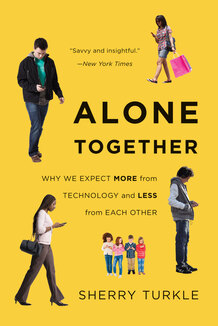
Some of the important topics she covers with application for Youth Service Librarians include the impact of digital devices on young children in the midst of developing individual identities, the impact of facebook and social networking on teen identity and teen's inability to reinvent themselves today, and the psychology of cyber-bullying in a virtual, rather than face-to-face world. I was particularly interested in the inability for children to separate the school day from the home because of these digital social ties. Whereas children used to be able play with identity, and "shut off" their social selves and social identities once in the privacy of homes, they now continue those social interactions and contests throughout the day and evening.
As someone who so often espouses the virtues of technology and the need for libraries to continue to expand and develop their digital outreach, this interview led me to pause. While I still think we must continue to implement these digital technologies, we have to be sure to redouble our efforts to teach media literacy and responsible digital use. In particular, cyber-bullying is an area that librarians can take a real leadership role in discussing the issues, providing opportunities for discussion and solutions, and display available tools and resources to counteract such behavior.
Interestingly, this month's K-12 Professional Book Club at the University of Illinois will address this same issue. Dorothy L. Espelage, a UIUC faculty member and one of the co-authors of Bullying Prevention & Intervention: Realistic Strategies for Schools, will be in attendance on Tuesday, November 6th to discuss her book (co-authors Susan M. Swearer, Dorothy L. Espelage, and Scott A. Napolitano). This session will also be offered online, if anyone is interested. I look forward to finding the time to read both of these books--I think they will potentially work well in concert--and I hope to be able to virtually attend this session.
As we continue to develop digital and mobile libraries, we constantly have to make sure we are considering the consequences of such technologies upon our young people so that we can both best utilize these tools, and ensure they complement a supportive and nurturing youth environment.
Subscribe to:
Posts (Atom)