Butterfly

Butterfly in the sky ... I can fly twice as high
Showing posts with label Media. Show all posts

Wednesday, October 24, 2012

Alone Together: Technology and Socializing


NPR never fails to provide a wealth of good information and talking points. I came across this great review and discussion in NPR Books. Author Sherry Turkle's new book Alone Together: Why We Expect More from Technology and Less from Each Other examines the changes and consequences of our increasingly digital and plugged-in worlds. She postulates that even in this digitally connected world, we often find ourselves feeling very much alone.
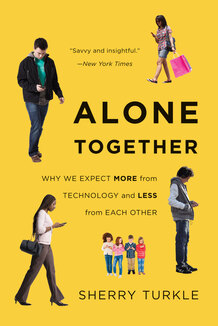

Alone Together book cover


Some of the important topics she covers with application for Youth Service Librarians include the impact of digital devices on young children in the midst of developing individual identities, the impact of facebook and social networking on teen identity and teen's inability to reinvent themselves today, and the psychology of cyber-bullying in a virtual, rather than face-to-face world. I was particularly interested in the inability for children to separate the school day from the home because of these digital social ties. Whereas children used to be able play with identity, and "shut off" their social selves and social identities once in the privacy of homes, they now continue those social interactions and contests throughout the day and evening.

As someone who so often espouses the virtues of technology and the need for libraries to continue to expand and develop their digital outreach, this interview led me to pause. While I still think we must continue to implement these digital technologies, we have to be sure to redouble our efforts to teach media literacy and responsible digital use. In particular, cyber-bullying is an area that librarians can take a real leadership role in discussing the issues, providing opportunities for discussion and solutions, and display available tools and resources to counteract such behavior. 

Interestingly, this month's K-12 Professional Book Club at the University of Illinois will address this same issue. Dorothy L. Espelage, a UIUC faculty member and one of the co-authors of Bullying Prevention & Intervention:  Realistic Strategies for Schools, will be in attendance on Tuesday, November 6th to discuss her book (co-authors Susan M. Swearer, Dorothy L. Espelage, and Scott A. Napolitano).  This session will also be offered online, if anyone is interested. I look forward to finding the time to read both of these books--I think they will potentially work well in concert--and I hope to be able to virtually attend this session. 

As we continue to develop digital and mobile libraries, we constantly have to make sure we are considering the consequences of such technologies upon our young people so that we can both best utilize these tools, and ensure they complement a supportive and nurturing youth environment.


Wednesday, September 19, 2012

Librarydoor: The Scarlet P ?

Check out this blog post and the Arthur cartoon about plagiarism:

Librarydoor: The Scarlet P ?: Try this  Plagiarism Arthur episode -- This is a short  winner. Not only does this short two minute cartoon support CCS   Writing 8 but it h...

Thursday, September 13, 2012

Early Literacy Skills and Technology


Researchers, psychologists, librarians, and parents all seem to agree that it is never too early to start reading to your child. Even in utero reading could have benefits in building aural connections between the child and the parents’ voices. All agree, the earlier we start, the better.

But is there a time when it is too early to utilize technology in reading?

……..

I am always interested in the possibilities and challenges that technology offers to the modern library. Technology and media has already drastically transformed our adult and teen library spaces. I wonder how/if technology can benefit early literacy programs in the library. Obviously we can utilize library web pages to offer resources for parents and to market our programs, but are there advantages or disadvantages to introducing technological tools into storytelling and early childhood programs? Do these tools inhibit the shared reading environment?

Studies have found a significant correlation between when shared reading begins for a child and language scores at the age of four and that 9 out of 10 of those children who begin schooling as poor readers in 1st grade will still be a poor reader in 4th grade.  We also know that children aged 4-6 living in a high-TV household, are far less capable of reading (34% vs 56%).[1]  But at the same time, all I ever hear from parents is how the iPad is the most important new learning tool for young children, replete with a wealth of educational applications. Now I don’t mean to imply that television and an educational iPad application are the same experience. The iPad inherently demands a more shared experience than television does, but I don’t believe an iPad demands the level of sharing that book-reading, or group storytime can offer. 

Furthermore, having shared reading time between child and caregiver is essential, but as Every Child Ready to Read emphasizes, it is also important how you read with a child to emphasize early literary skills. For young children sensory experience is so important to how they learn. Whether that’s tactile, aural, visible, or even oral, these are all experiences that young children can have with a physical book, and with the physical space of children’s libraries. And young children also improve memory retention when they are emotionally involved, something that can be hard to replicate through technology. Ultimately, if we can use technology while maintaining the social, loving, dialogic, parent-child relationship that lies at the core of shared reading they can be a benefit, but these elements can NOT get lost in the sweep of this digital era.

That said, don’t we also have a responsibility to prepare our children for that digital world? Such goals are becoming essential to curricular goals as children grow older. What age or level of development do you think is right to introduce such tools? How are you using today's tech tools--computers, electronic games, tablet devices—in your early literacy program, if at all? I am very curious about the role of technology in early childhood development and would love to hear some of your experiences!


[1] Statistics cited in Saroj Nadkarni Ghoting and Pamela Martin-Díaz, Early Literacy Storytimes @ Your Library: Partnering with Caregivers for Success  p6-10; Also see Maryanne Wolf, and Catherine J. Stoodley. Proust and the Squid: The Story and Science of the Reading Brain. Ch. 4, pp. 81-107

Monday, September 10, 2012

Study Like a Scholar, Scholar


While settling into the work week on this Monday morning, I have been reading a lot about user-need and library instruction. Somehow that vein of inquiry has brought me here.

Check out this video from the Brigham Young University's Library Multimedia Crew. Sure, its over 2 years old, but if its not new to you, it is to me. If you have not seen it, check it out. Its kinda awesome.

Do you think this type of video is something that can actually help market the school/university library? Is it worth the investment of time and money? What if it weren't so darn good?

Let  me know what you think.

Cheers!